
AI's Offensive Line
Why AI’s Future Depends on Data Centers and Innovation in the Trenches

Tis the season. Football is back, the game that brings people together from all walks of life to watch their favorite team or alma matter go to war on Saturday or Sunday (or Monday, Thursday and even Friday. What a blessing).
With this comes the fan filled emotions from the highlight-reel plays, overtime battles and Hail Mary miracles. That being said, there are two types of fans out there. The casual fan who enjoys watching the game, sees a bunch of players running around and then hitting a TikTok dance after the occasional touchdown that lights up the scoreboard. Then there’s the fan that sees the X & O’s that go into the poetry in motion from the snap of the ball, the pulling guard, the TE down block and the WR crack back that springs Saquon loose on a pitch to the edge.
You don’t need to be a student of the game to see that the battles at the line of scrimmage decide outcomes. The same is true in AI: every yard of progress depends on the concrete, copper, cooling and software inside data centers. They may be invisible to most fans (users), but as AI demand explodes, this infrastructure is becoming the bottleneck, and the innovation happening on the o-line will determine how far the game will go. Let’s dive in.

Scouting Report
To level set for those new to the game — what are data centers and why are they important? In practical terms, a data center is a facility that houses servers, networking equipment, and cooling systems, providing the secure, always-on infrastructure that powers everything from streaming and e-commerce to AI training and edge computing.
They come in all shapes and sizes so lets break down the roster:
Hyperscalers — such as AWS, Google, Microsoft and Meta, who operate massive, global networks to power their own cloud and AI workloads
Colocation providers — like Equinix, Digital Realty and CoreSite, which rent out space, power, and connectivity to enterprises that don’t want to build or manage their own facilities
Enterprise data centers — privately owned / built and run by large corporations (banks, healthcare systems, governments) to host their own mission-critical applications
Edge data centers — smaller, distributed facilities placed closer to end-users and devices, enabling real-time applications like autonomous vehicles, smart cities, and IoT
The key difference comes down to scale and purpose: hyperscalers and colos operate at massive, shared scale; enterprises build for their own needs; and edge centers focus on speed and proximity.
Think of data centers as the offensive line of the digital economy. They’ll never make the highlight reel, but they’re the ones protecting and enabling the skill players, including AI models, cloud platforms, and apps, so the big plays can actually happen.
Under the hood, the stack revolves around four components: compute (servers and chips that do the processing), storage (where the data lives), network (the connective tissue that moves data such as power cords, cables, routers and firewalls), and power and cooling (the backbone that keeps everything running).
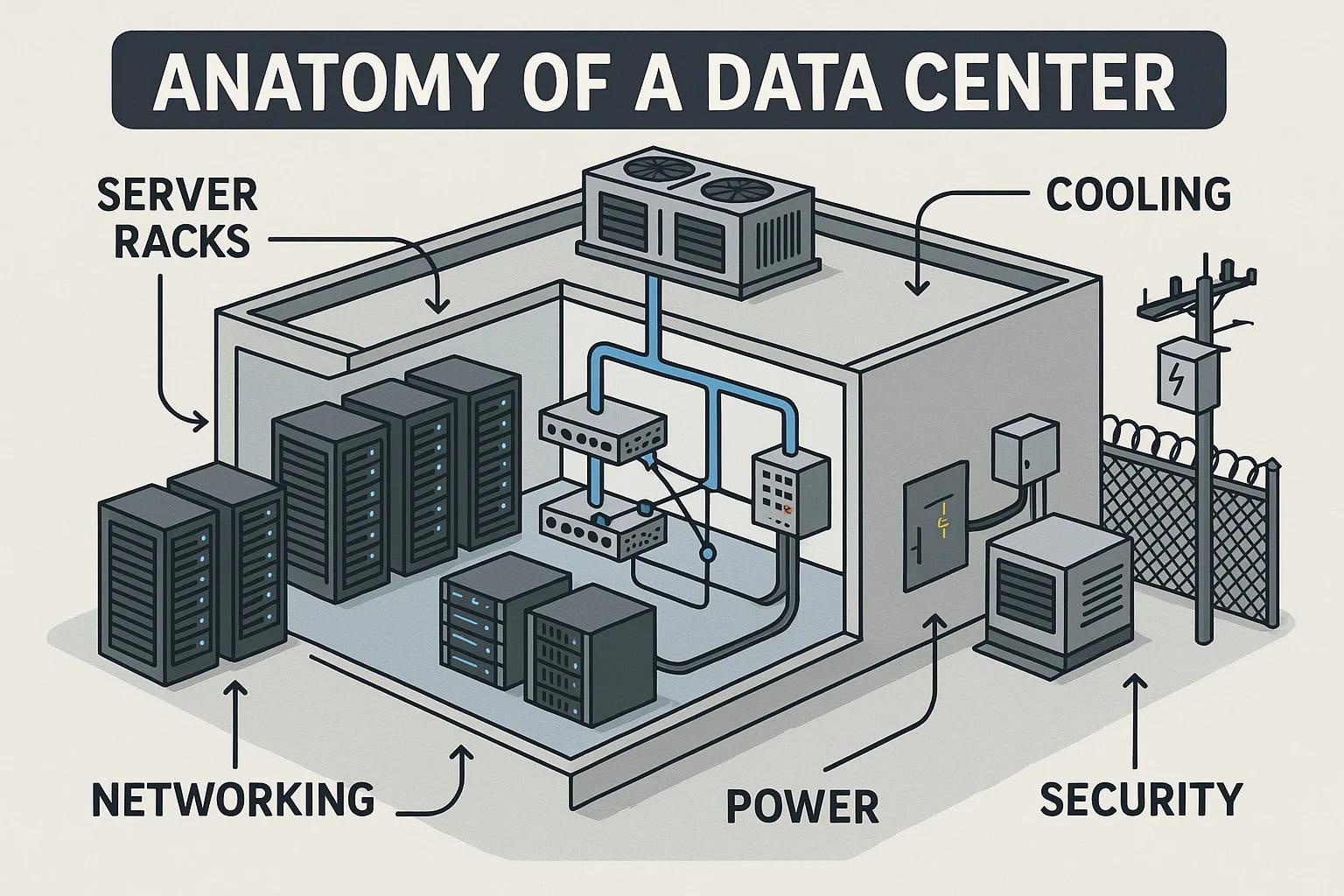
The challenge is that as AI workloads continue to surge, each of these core layers of the data center stack is being pushed to its breaking point, creating the growing capacity constraints.
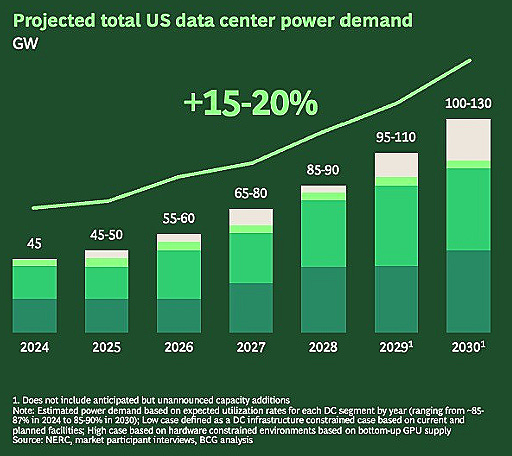
The supply-demand imbalance is massive: U.S. data center capacity today is ~50 GW, but demand is projected to nearly triple to ~130 GW by 2030, a 20%+ CAGR fueled by AI and high-performance computing. Globally, McKinsey estimates nearly $7 trillion in data center capex over the next decade, covering everything from servers and power generation to land and labor, reflecting one of the largest infrastructure buildouts in modern history.
The Game Plan
When people talk about the evolution of football positions, most focus on the quarterback. From the undersized 5’10”, 180-pound Doug Flutie to today’s dynamic athletes like Jalen Hurts — 6’1”, 223 pounds, squatting 600lbs in college — the quarterback has become bigger, faster, and more versatile.

Very few highlight the evolution of the lineman: from the 6’2”, 280-pound guards who filled space, to today’s 6’6”, 315-pound linemen running sub-5.0 forties and hitting backflips with textbook form.

In parallel, when people talk about AI, the spotlight is on the applications: the agentic tools, copilots, and workflows that make processes faster, smarter, and more efficient. That’s where the excitement (and investment) naturally flows. But very few pay attention to the innovation happening on the line, inside the data centers themselves, even though that’s where the success of AI ultimately depends.
Optimizing existing systems is critical for resiliency, efficiency, and scalability. The inevitable spend on expanding and upgrading data center capacity will spark innovation across four fronts:
Hardware – Controlling the Line of Scrimmage
Traditional servers can’t keep up with AI workloads so need to invest in breakthrough solutions in chips, accelerators, and networking
Advanced cooling is critical: rack densities are pushing beyond 100 kW (essentially burning a ton of electricity creating intense heat), making air cooling inefficient
Liquid immersion and waterless cooling are emerging to cut waste and enable higher-density compute
Software & Automation – Smarter, Self-Adjusting Systems
Data centers are becoming too complex for humans to manage with manual processes
Workload optimization and compliance automation will continue to replace manual oversight, making sure jobs are running under regulatory standards
AI-driven orchestration will help to balance workloads across servers, reduce wasted energy, and spot problems before they lead to downtime
Edge Infrastructure – Beyond the Traditional Player
Not all data should run back to massive hyperscale centers
Micro data centers and 5G-enabled networks bring compute closer to the source
This lowers latency and enables real-time services for factories, vehicles, and IoT systems
Sustainability Tech – Scaling Responsibly
Data centers already consume ~3% of global electricity and producing ~2% of global CO2 emissions
This is driving innovation in alternative energy sources including geothermal, nuclear, hydrogen and long-duration storage
AI-driven management systems are dynamically adjusting cooling systems, reducing waste, and running only when clean energy is available
The real winners will be the teams that invest early and intelligently in these unseen infrastructure innovations. Without resilient, efficient and scalable infrastructure, AI’s highlight-reel moments will be much harder to come by.
Don’t Skip Film..
Film sessions prep you for game day. They reveal the opponent’s tendencies, strengths, weaknesses and gaps. The work you put in off the field determines your success on it. The same principle applies to data center infra: as an investor or stakeholder, you need to understand the risks including capital intensity, competition, resource constraints and shifting regulations.
Building hardware like chips, cooling systems or modular data centers requires significant upfront spend and long development cycles. To manage this, smart investors co-invest with strategics to share the capital load or back asset-light, software-driven solutions that scale more efficiently.
It’s also critical to understand the game plan of the hyperscalers such as AWS, Microsoft, Google and Nvidia. These giants sit at the forefront of data center innovation, with massive purchasing power and seemingly unlimited resources. And they’re putting those resources to work:
Microsoft committed nearly $80B through 2028 for AI-optimized data centers, including edge, sovereign cloud, and sustainability systems
Google announced a $25B investment in new data centers and AI infrastructure across the PJM power market region (Mid-Atlantic and Midwest U.S.)
Nvidia, through its inception program, is backing startups like Emerald AI, an AI-powered conductor platform enabling data centers to dynamically adjust power consumption and act as intelligent grid assets
These moves show how hyperscalers are setting the pace and reshaping the landscape. For startups, that creates a paradox: hyperscalers are both the biggest customers and the toughest competitors. The path forward is to back companies with unique IP or deeply integrated solutions that hyperscalers can’t easily replicate.
The Playmakers
While hyperscalers dominate the headlines, a wave of early-stage startups are reshaping the future of data center infra in ways that could define AI’s trajectory. In addition to Emerald AI, here are a few others worth taking note of:
ZutaCore (Cooling Innovation) – Raised a $40M round led by ZIM Ventures and is pioneering waterless, direct-on-chip liquid cooling
Exowatt (Sustainability / Power) – Backed by investors including Felicis, a16z and Atomic, Exowatt is a Series A company that raised $90M to build modular solar-thermal energy storage systems that deliver clean, round-the-clock power
TensorWave (AI-Native Cloud) – Raised $100M+ in their Series A led by AMD Ventures, Nexus, and Magnetar Capital. The Company is building next-generation cloud infra designed for demanding workloads
Flexnode (Edge Infrastructure) – Raised $10M+ to scale modular, distributed data centers that can be deployed quickly in underserved regions and paired with renewables, helping extend compute closer to users where hyperscalers struggle to secure land and power
These are the kinds of startups that may not get SCTop10 airtime, but they’re quietly redefining the playbook for AI infra. From cooling and chips to power and edge deployment, they represent the kind of innovation that will decide how far AI can actually scale.
Locker Room Wrap
Chasing flashy AI apps is tempting and it’s where most of today’s hype is. But the real wins will come from backing the unseen infrastructure that makes those apps possible. For investors, founders and builders, the job is to become a true student of the game, understand the risks and support the players laying the foundation. That’s where the real battles are fought, and where the future of AI will be decided.
Love this!